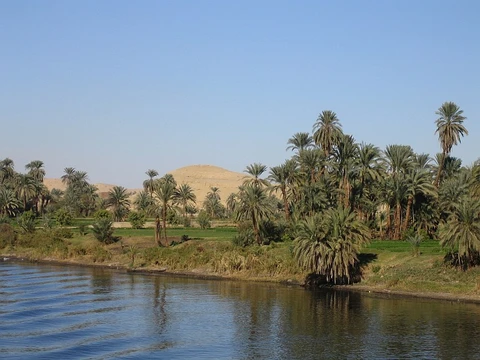
Orange River
Longest river in South Africa, vital for irrigation and hydroelectric power.

via Wikipedia: Orange River · see source
The Orange River (from Afrikaans/Dutch: Oranjerivier) is a river in Southern Africa. It is the longest river in South Africa, with a total length of 2,432 km (1,511 mi). It rises in the Drakensberg mountains in Lesotho, flowing westwards through South Africa to the Atlantic Ocean. The river forms part of the international borders between South Africa and Lesotho and between South Africa and Namibia, as well as several provincial borders within South Africa. Except for Upington, it does not pass through any major cities. The Orange River plays an important role in the South African economy by providing water for irrigation and hydroelectric power.
- length
- 2,432 km (1,511 mi)
- source
- Drakensberg mountains, Lesotho
- mouth
- Atlantic Ocean between Oranjemund (Namibia) and Alexander Bay (South Africa)
- basin_area
- 973,000 km² (376,000 sq mi)
- named_after
- House of Orange (Dutch ruling family)
- other_names
- Gariep River, Senqu River, iGqili, !Garib
Lore & Background
The Orange rises in the Drakensberg mountains along the border between South Africa and Lesotho, about 193 km (120 mi) west of the Indian Ocean and at an altitude of over 3,000 m (9,800 ft). The extremity of the Orange River inside Lesotho is known as the Senqu. Parts of the Senqu River freeze in winter because of the high altitude, creating droughts downstream that mainly affect goat and cattle production. The river then runs westward through South Africa, forming the south-western boundary of the Free State province. In this section, the river flows first into the Gariep Dam and later into the Vanderkloof Dam. At the western point of the Free State, southwest of Kimberley, the Orange meets with its main tributary, the Vaal River. From here, the river flows further westward through the arid wilderness of the southern Kalahari region and Namaqualand in the Northern Cape province to meet with Namibia at 20°E longitude. From here, it flows westward for 550 km (340 mi), forming the international border between the province and Namibia's ǁKaras Region. The river can be crossed at Vioolsdrif / Noordoewer, Alexander Bay / Orangemund border crossing by road and the Sendlingsdrif border crossing by ferry. In the last 800 km (500 mi) of its course, the Orange receives many intermittent streams (such as the Fish River). The Augrabies Falls are located on this section, where the river descends 56 m (184 ft) in a course of 18 km (11 mi). The Orange empties into the Atlantic Ocean between the small towns of Oranjemund (meaning "Orange mouth") in Namibia and Alexander Bay in South Africa. It is a recognised Ramsar site. Some 33 km (21 mi) from its mouth, it is obstructed by rapids and sand bars and is generally not navigable for long stretches.
Reader's Guide
As the primary source of water for the majority of South Africa, the Orange River plays a crucial role in supporting agriculture, industry, and mining. Two large water schemes have been created: the Orange River Project and the Lesotho Highlands Water Project. Historically, the river played an important role in the South African diamond rush, with the first diamonds in the country being discovered in alluvial deposits on the Orange. Today, commercial diamond mines operate along the final stretch of the Orange River and around its mouth. Because of the lack of dangerous animals and high water levels during summer, the river is used for recreational canoeing and rafting. Orange River rafting has become very popular, with many companies using their camps along the river from which to operate. The most popular trips are four-day and six-day river trips that take place either along the gorge below the Augrabies Falls or along the Richtersveld area. The river was named the Orange River in honour of the Dutch ruling family, the House of Orange, by the Dutch explorer Robert Jacob Gordon. Other names include !Garib, rendered in Afrikaans as Gariep River, Groote River, or Senqu River (used in Lesotho). It is known in the isiXhosa as iGqili. Since the end of apartheid, the name "Gariep" has had greater favor in official correspondence in South Africa.
Did You Know?
- The Orange River is the longest river in South Africa, with a total length of 2,432 km (1,511 mi).
- Parts of the Senqu River (the Orange's extremity inside Lesotho) freeze in winter because of the high altitude, causing droughts downstream that affect goat and cattle production.
- The Augrabies Falls on the Orange River descend 56 m (184 ft) in a course of 18 km (11 mi).
- The river was named the Orange River in honour of the Dutch ruling family, the House of Orange, by the Dutch explorer Robert Jacob Gordon in 1779.
Frequently Asked Questions
What is the Orange River?
It is the longest river in South Africa, running 2,432 km from the Drakensberg highlands in Lesotho westward to the Atlantic Ocean. Along stretches of its course it doubles as a natural border between South Africa and both Lesotho and Namibia.
How long is the Orange River and how big is its basin?
The river measures roughly 2,432 km (1,511 mi) from source to mouth. Its drainage basin spans about 973,000 km², making it one of the largest river systems in southern Africa.
Where does the Orange River start and where does it empty?
It rises in the Drakensberg mountains of Lesotho and flows generally westward across South Africa before reaching the Atlantic Ocean between Oranjemund (Namibia) and Alexander Bay (South Africa).
Why is it called the Orange River?
The name traces back to the Dutch House of Orange, the royal family that ruled the Netherlands during the colonial era in the region. Indigenous and Afrikaans communities also know it by names such as Gariep, Senqu, iGqili, and !Garib.
Why is the Orange River important to the region?
It supplies water for large-scale irrigation and hydroelectric power generation, making it a backbone of the South African economy. Its basin also sustains ecosystems and communities across Lesotho, South Africa, and Namibia.
More in Rivers Of The World 1-20
Spotted an error? Know more?
This is a living reference — every entry is fact-audited, and reader corrections feed straight into our audit queue. Suggest an edit · See this site's audit record